The Florida Inspection Period: What Buyers Need to Know
Every Florida residential purchase includes an inspection period, and in a luxury transaction that window typically runs 10 to 15 days. During that time a buyer can order any inspections they want, review the findings, and cancel the contract for any reason with full deposit recovery. This is not a special clause negotiated for high-end buyers. It is the structure of Florida’s standard AS-IS Residential Contract, which governs transactions across the state at every price point.
Florida requires all general home inspectors to be licensed. Under Florida Statutes Chapter 468, Part XV, inspectors must complete 120 hours of state-approved training, pass a standardized examination, and carry a minimum of $300,000 in general liability insurance along with errors and omissions coverage. The Florida Department of Business and Professional Regulation administers licensing and enforcement. Hire only a licensed inspector. The credentials matter for your insurance carrier and for any legal protections you may need to assert after closing.
A licensed general inspector covers structural components, roof covering, electrical systems, plumbing, HVAC, interior and exterior elements, and site conditions. What the standard inspection does not cover: swimming pools, seawalls, boat lifts, docks, elevators, and most specialty systems. For a luxury property, that exclusion list covers a significant portion of the property’s value. A 6,000 square foot estate with a resort-style pool, outdoor kitchen, home elevator, and whole-home generator has multiple systems that require inspection well beyond what a general inspector is licensed or equipped to evaluate.
For a South Florida luxury purchase, a thorough buyer should plan on four distinct inspection types, and often additional specialist assessments depending on the property’s features.
The 4-Point Inspection and Your Insurance
A 4-point inspection covers four systems: roof, electrical, plumbing, and HVAC. It is formatted for insurance underwriters, not general buyers, and Florida carriers routinely require it before writing a homeowners policy on any home over a certain age, typically 20 to 30 years depending on the insurer.
South Florida has one of the most stressed homeowners insurance markets in the country. The 4-point inspection is where many luxury transactions run into complications. What it surfaces is not cosmetic. An inspector who documents a tile roof with a 23-year-old underlayment, aluminum branch circuit wiring in a 1980s waterfront estate, or polybutylene supply lines is handing the buyer information that directly determines whether they can obtain insurance at all, and at what cost.
- Roof: Age and condition of both the surface material and the underlayment beneath it. Many Florida carriers will decline or non-renew policies on homes with roofs over 20 years old, regardless of how the tile looks from the street.
- Electrical: Panel type, age, and wiring material. Homes with Federal Pacific or Zinsco panels, or with aluminum branch circuit wiring rather than copper, face coverage restrictions or significant surcharges.
- Plumbing: Material type, which affects long-term failure risk. Polybutylene supply lines were common through the 1990s and are now associated with chronic failure; many carriers will not cover properties with active polybutylene plumbing.
- HVAC: Age and general condition of all heating and cooling equipment. Systems over 15 years old are routinely flagged as material issues by underwriters.
The Florida Office of Insurance Regulation provides guidance on homeowners insurance requirements and insurer obligations. What a 4-point reveals doesn’t necessarily end a deal, but it resets the buyer’s understanding of what the property will actually cost to insure. On a $4 million waterfront home, annual premiums can reach $40,000 to $80,000 or more depending on coverage structure and construction vintage. A 4-point finding that triggers a carrier decline or forces placement in a surplus lines market can add $15,000 to $25,000 annually to that figure. Know that number before you close.
Roofing: Florida’s Most Consequential Inspection Item

Roofing is the single most inspected item in a Florida real estate transaction. South Florida’s combination of intense UV exposure, tropical rainfall, and hurricane-force wind creates conditions that shorten roof life relative to most of the country. And the insurance market’s acute sensitivity to roof age makes condition a direct transactional variable, not just a maintenance consideration.
Luxury properties in South Florida use several roofing systems, each with distinct inspection priorities.
Concrete and clay tile is the most common on South Florida estates. Tile itself can last 50 years or more with minimal maintenance. The underlayment beneath it does not. A felt or synthetic underlayment on a tile roof typically lasts 20 to 30 years, and that underlayment is what keeps water out of the structure when tile shifts or cracks. An inspector who only looks at visible tile is missing the most critical part of the assessment. Ask specifically about the underlayment installation year, its condition at the eaves and around penetrations, and whether it meets current wind load requirements. A tile roof with a 22-year-old underlayment may look perfect from the driveway and still be uninsurable under current carrier guidelines.
Standing seam metal roofing is increasingly common on contemporary luxury construction. Metal handles Florida’s wind load well, achieves superior impact ratings when properly installed, and qualifies for meaningful windstorm insurance discounts. Inspect the flashing at all penetrations, the sealant condition at fasteners, and the connection between the roof panels and the structure. Thermal expansion in South Florida’s heat causes movement over time, and degraded sealant at fastener points is a frequent leak source.
Low-slope and flat systems appear on sprawling estates with connected wings, covered loggias, motor courts, or upper deck areas. These membranes — modified bitumen, TPO, or built-up systems — require inspection of drainage points, penetrations around HVAC equipment, and the overall membrane condition. Blocked drains and pooling water are the primary failure modes, and they are easy to miss on a property with complex roofline geometry.
Beyond condition, roof geometry affects insurance cost. Hip roofs, where all sides slope downward from a central ridge, perform better in high-wind events and qualify for stronger mitigation credits than gable roofs, which have triangular end walls that present more wind exposure. When comparing two otherwise similar properties, a hip-roof home will carry lower windstorm premiums. This is a real number to request from your insurance agent before finalizing an offer.
HVAC Systems in a Large Florida Estate
A standard home runs on one or two HVAC units. A luxury property in South Florida does not. A 6,000 square foot estate typically has three to six separate systems serving distinct zones: master suite, guest wing, primary living area, home theater, kitchen, and service areas each on their own air handler. Every unit has its own age, efficiency rating, maintenance history, and refrigerant type. The general inspection will document what’s there. Understanding what it means requires more specific analysis.
- Age: HVAC equipment has a useful life of 10 to 15 years in South Florida’s heat and humidity. Equipment over 12 years old should be treated as approaching replacement and budgeted accordingly, regardless of current function. A property with five HVAC units averaging 11 years old is, statistically, 18 to 36 months from its first major replacement cycle.
- Refrigerant type: Systems running R-22 (Freon) cannot be legally recharged if they develop a leak. R-22 production was phased out nationally in 2020. Any system still running on R-22 is operating on a closed loop of remaining refrigerant, and a leak means replacement, not repair. R-410A is the current standard for existing equipment, though the industry is transitioning to R-454B in new installations as of 2025 and 2026.
- Duct condition: Flexible ductwork in South Florida attic spaces runs through an environment that routinely exceeds 140 degrees in summer. Insulation degrades, duct sections separate at connections, and mold can establish inside the ductwork itself. A duct leakage test quantifies losses and identifies disconnected sections that a visual inspection in an attic packed with mechanical equipment cannot access.
- Dehumidification: Standard split-system AC manages humidity during normal occupied use. Properties with variable occupancy or extended vacancy periods — common in luxury second homes and seasonal estates — benefit from a dedicated whole-home dehumidifier. If one is not installed, inspect storage rooms, walk-in closets, and secondary bedrooms for moisture damage consistent with extended AC shutdowns or vacation-home thermostat management.
On a property with five or six HVAC units ranging from 8 to 14 years old, a buyer should budget $80,000 to $150,000 for phased replacement over the next five to seven years. That projection belongs in the acquisition analysis, not the surprise column after closing.
Mold, Moisture, and Air Quality Testing
A 2026 national analysis ranked Florida second only to Louisiana for residential mold risk. With average humidity between 74 and 90 percent year-round, and Miami recording over 60 inches of annual rainfall, South Florida creates conditions where mold can establish behind walls, under flooring, inside HVAC systems, and in attic spaces within days of a moisture event.
A general home inspection includes visual assessment for mold. That is not sufficient for a luxury purchase. Order an independent air quality test. A qualified indoor air quality specialist places air sampling cassettes in living areas, mechanical rooms, and the attic, then sends them to an accredited laboratory. Results return in 48 to 72 hours and document actual spore types and concentrations in the air, not just what is visible on surfaces.
The triggers for mold growth in South Florida luxury homes are predictable:
- Prior water intrusion through the roof, windows, or sliding glass doors that was cosmetically repaired without full remediation behind the wall or under the flooring
- HVAC air handlers that have run for extended periods without coil cleaning, accumulating mold colonies inside the equipment that then circulate through the home’s ductwork
- Properties that sat vacant with the AC turned off or set above 80 degrees for more than a week, which is common with estate sales and seasonal second homes between occupancy periods
- Plumbing leaks inside walls, particularly at the kitchen, master bath, or wet bar areas where supply lines run through enclosed cabinetry for extended periods before being discovered
A professional air quality test costs $300 to $600 statewide. Mold remediation in a luxury home, depending on scope, ranges from $5,000 for a localized bathroom situation to $50,000 or more when the problem spans multiple rooms or has infiltrated the ductwork. The comparison makes the testing cost self-evident.
Pool, Spa, and Outdoor Living Systems
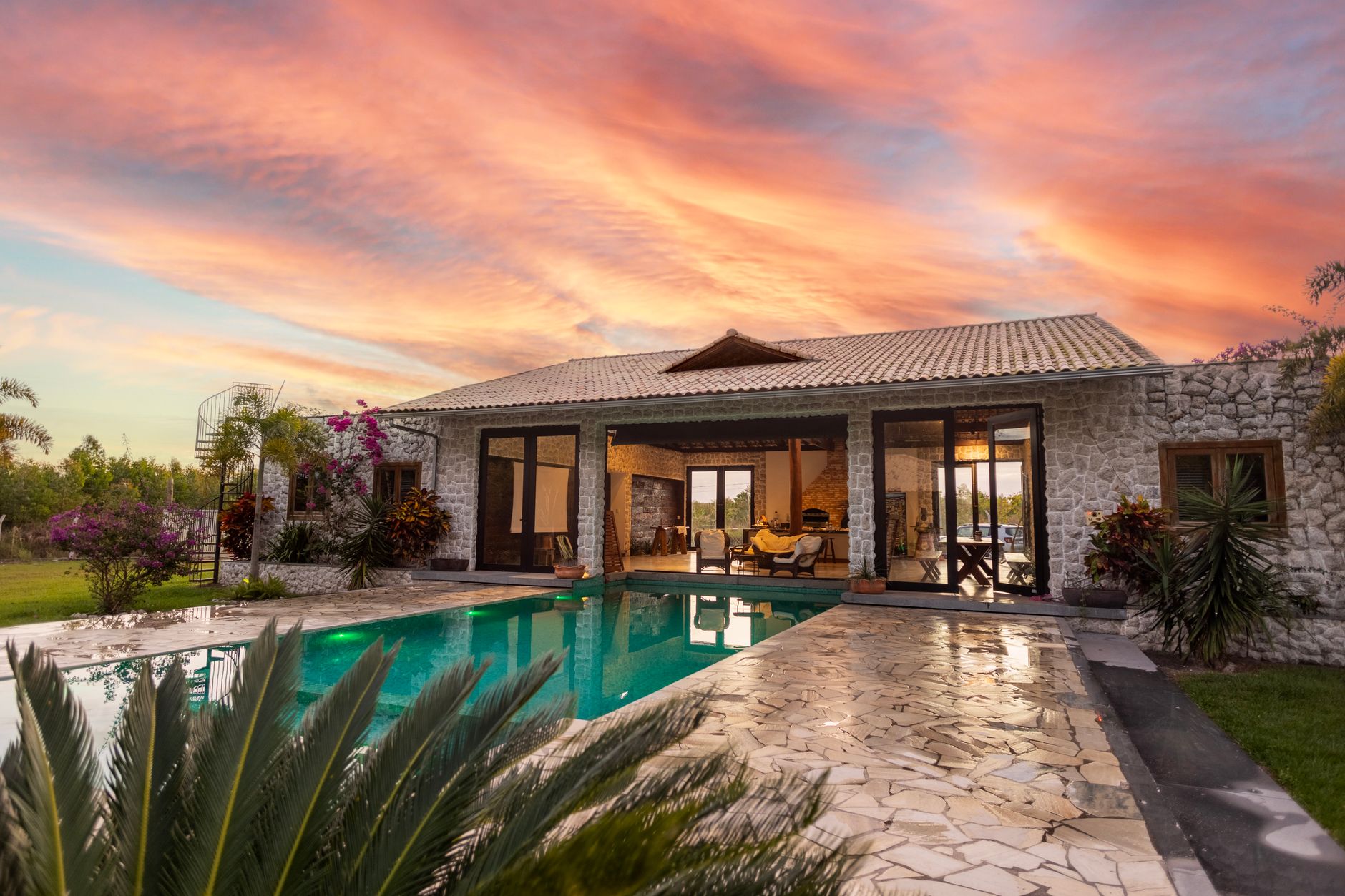
Florida’s standard home inspection does not require pool inspection. For a luxury property with aquatic features, a buyer should always engage a separate specialized pool and spa inspector. The cost runs $150 to $400. Given what can go wrong with South Florida pool systems, that cost is among the most direct-return expenditures in the inspection period.
The pool inspection should evaluate:
- Shell integrity: Cracks in the gunite or poured concrete shell, bond beam, coping, and surrounding decking. Horizontal cracks in the shell are more structurally significant than surface crazing or cosmetic plaster checking. Active water loss, measured by turning off the equipment and monitoring water level over 24 hours, indicates a shell or plumbing leak. A pool losing half an inch of water per day has a leak that needs to be located before it undermines surrounding decking or the pool equipment pad.
- Pool equipment: Pump, filter, heater, salt chlorinator, and automation controller. Luxury pool automation systems from Pentair, Hayward, and Jandy can be expensive to replace when they fail, and some older control systems are no longer supported with software updates. Document the age of all equipment and verify the automation system is still manufacturer-supported.
- Electrical bonding: Florida code requires all pool equipment, metal fittings, handrails, and ladders to be connected via a bonding grid that prevents voltage differences in the water. Corrosion of the bonding system or missing connections are a life-safety issue. Older pools frequently have degraded bonding that a general inspector will not flag because they are not looking for it.
- Screen enclosures: Pool cages in South Florida take repeated damage from UV exposure, wind, and storm events. Inspect the screen material, the aluminum frame for corrosion and bent structural members, and the anchoring into the deck and house structure. A storm-repaired enclosure that was not re-engineered to current wind load requirements may not hold in the next major weather event.
- Outdoor kitchens and gas systems: High-end estates frequently include built-in outdoor kitchens with gas burners, grills, and refrigeration. A licensed plumber should inspect the gas lines, shutoff valves, and connections. Gas lines and fittings exposed to salt air and South Florida humidity corrode faster than interior systems, and deteriorated fittings in an enclosed outdoor kitchen present a real risk.
Spa systems, water features, and fire features each add mechanical and electrical complexity. Operate every feature through a complete cycle during the inspection period. Visual assessment alone is not an adequate substitute for actually running the systems.
Electrical Capacity and Backup Power
Luxury properties carry electrical loads that standard residential wiring was not designed to handle. EV chargers, whole-home generators, extensive smart home and AV equipment, resort-style pool heating, home theaters, multiple commercial-grade kitchen appliances, and climate-controlled wine rooms all draw significant amperage. A 200-amp electrical service that was adequate for a 1990s luxury build may be running near capacity in a modernized estate today.
- Service capacity: Request the main panel specifications. A 6,000 square foot home with modern luxury systems, an EV charger, and a whole-home generator bypass often requires 400-amp service. If the property has 200-amp service and the buyer intends to add EV chargers or expand existing systems, an electrical service upgrade is a material cost to factor into the acquisition budget, not a minor line item.
- Generator and transfer switch: Whole-home standby generators are common and expected in South Florida luxury properties given hurricane season exposure. Inspect the generator for age, fuel type (propane and natural gas are more reliable for residential standby than diesel), rated load capacity relative to the home’s actual connected loads, and automatic transfer switch condition. A generator that has not been load-tested in the past 12 months and runs only on weekly auto-exercise cycles may not operate reliably under full load when a storm takes out grid power for an extended period.
- Elevator permits: South Florida estates frequently include residential elevators. Florida DBPR requires certificates of inspection and regular inspection cycles for all residential elevators. Verify that the elevator carries a current certificate and ask for maintenance records. An elevator not inspected on schedule may require remediation as a condition of transfer, and the remediation cost and timeline can affect closing.
- Smart home and AV systems: General inspectors do not inspect smart home automation, lighting control, structured wiring, distributed audio, or AV equipment. These systems can represent $200,000 to $1 million or more in a high-end custom installation. If the property has a significant system, engage the original installer or an independent technology specialist to document what is in place, what is functional, and what the support status is for any proprietary hardware or software.
Smart home technology ages on a shorter cycle than the house around it. A Crestron or Control4 system installed in 2013 may be running on discontinued hardware with no current software support. Whether the seller’s price reflects a premium for that system, or whether the buyer is inheriting an expensive-to-support legacy installation, is a question worth answering before the inspection period closes.
The Wind Mitigation Inspection
The wind mitigation inspection is a separate engagement from the general inspection and from the 4-point. It is performed by a licensed inspector using a state-standardized form, and its sole purpose is to document the wind-resistant features of the structure so that insurers can calculate premium discounts accurately.
As of April 1, 2026, Florida updated the Uniform Mitigation Verification Inspection Form (OIR-B1-1802). The revised form changes how homes are evaluated and documented for windstorm coverage. Insurers are expected to apply credits under the new standards beginning July 2026. A wind mitigation inspection ordered now should use the current form to ensure the credits are properly calculated by your carrier. The Florida Office of Insurance Regulation maintains resources for homeowners and inspectors on wind mitigation standards and the current form requirements.
What the inspection evaluates:
- Opening protection: Every exterior window, door, and garage door is assessed for impact rating and protection type. Impact-rated glazing and impact-rated doors generate the largest single category of windstorm discount for most Florida homes. Full opening protection is the goal for luxury properties in high-wind exposure zones.
- Roof deck attachment: How the roof sheathing is fastened to the rafters or trusses. The nail pattern and nail type determine how well the deck resists uplift force during a storm.
- Roof-to-wall connection: How the roof structure connects to the exterior walls. Clips, single wraps, double wraps, and structural member connections each carry different credit values. Double wraps and structural member connections produce the highest credits and the best storm performance.
- Secondary water resistance: The underlayment layer between the roof deck and the covering. Self-adhering underlayment qualifies for an additional credit because it prevents water intrusion if the primary covering is lost in a storm event.
A luxury home with full impact protection on all openings, a hip roof, double-wrap or structural roof-to-wall connections, and secondary water resistance can reduce the windstorm portion of its premium by 25 to 45 percent. On a $50,000 annual policy where windstorm accounts for half the total, that reduction represents $6,250 to $11,250 in annual savings. The inspection costs $125 to $200 and takes less than an hour. It is one of the highest direct-return expenditures available to a Florida luxury buyer in the first month of ownership.
Inspection Strategy, Timing, and Negotiation
The inspection period moves fast. Fifteen days sounds like adequate time, but coordinating a general inspector, a 4-point, a pool specialist, an air quality tester, a wind mitigation inspector, and additional specialists for elevators, generators, or smart home systems requires a plan. Order the general inspection first — within the first two to three days of the inspection period — to identify the major systems and potential issues. Use those findings to prioritize specialist orders. Many inspection firms in South Florida handle general, 4-point, and wind mitigation in a combined visit, which reduces coordination overhead significantly.
Florida’s AS-IS Residential Contract gives the buyer the right to cancel and recover the deposit during the inspection period, for any reason or no reason at all. It does not give the buyer the right to demand repairs. This distinction surprises buyers from other states. You cannot compel a seller to replace the roof. You can choose to walk away because the roof needs replacing, or you can negotiate.
In luxury transactions, sellers almost always negotiate when inspection findings surface material issues. A seller whose home has been listed for 60 days will not re-list and carry a $4 million property through another full marketing cycle over a $40,000 pool shell repair. The key is approaching that negotiation with specific numbers rather than inspection report language. An inspector writes: HVAC systems are aged and approaching end of useful life. A contractor writes: replacement of five HVAC systems with current-generation equipment, installed and commissioned: $112,000. The contractor’s quote is the negotiating instrument. Bring quotes, not reports.
Order all specialist inspections within the first seven days of the inspection period so results are in hand with time to request contractor bids before the deadline. Waiting until day 12 to discover the pool equipment needs full replacement and three of the five HVAC units are over 14 years old leaves no time to properly quantify the exposure.
At MJI Realty Group, we walk buyers through inspection strategy before the contract is signed. Knowing what to look for, which specialists to retain, and how to use inspection findings constructively in a negotiation is part of what a boutique brokerage with deep South Florida experience provides. If you are purchasing a luxury property in Miami-Dade, Broward, or Palm Beach County and want to approach the inspection period with a clear plan, reach out directly.
Real estate decisions depend on individual circumstances; this is general information, not legal, tax, or investment advice for your specific situation.